Arjen de Boer on the rise of Statement of Work and why that’s good news for young talent
We talk a lot about labor market shortages. About aging populations. About how hard it is to find good people. And at the same time, we’re sidelining an entire generation. Digitization and artificial intelligence are increasingly taking over tasks, especially in large institutions like government bodies, banks, and insurers. Efficient? Absolutely. But the result is that many entry-level jobs are disappearing. And without an influx of young people, innovation dries up. It may sound like I’m preaching to the choir. But this goes beyond House of Redmore. This is a societal issue: how do we ensure young people maintain a place in a labor market that’s becoming smarter, faster, and more digital?
The Influx Is Stalling
Recently, I sat down with a major bank urgently looking for mid-level and senior mortgage underwriters. I said: there are hardly any left. For years, fewer mortgages were issued, the influx from below stalled, and now that the market is picking up, the shortage is suddenly acute. The bank added that older clients prefer to be helped by people their own age. My response: “Everyone would like to be treated by someone their own age in a hospital, but that’s just not feasible. And young people really don’t do it any differently.” It sounds like a joke, but it’s a serious problem. If we don’t give young people a chance to gain experience, we shouldn’t be surprised later when there’s no one left with experience.
From Freelance Hiring to Integrated Teams
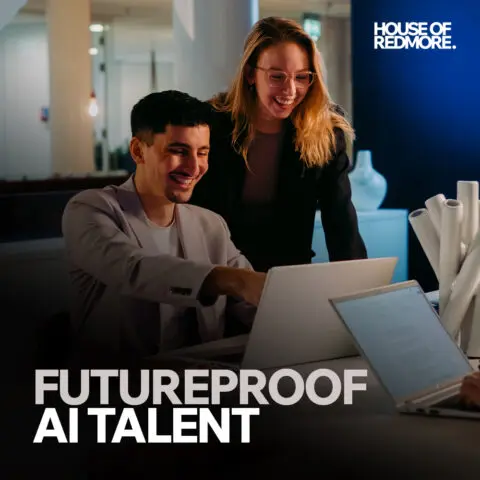
The solution isn’t more aggressive recruiting—it’s smarter organization. We need to move away from the idea of ad hoc hiring: one person, one rate, one temporary fix. The future lies in integrated teams where experience, knowledge, and innovation go hand in hand. A senior or mid-level professional working alongside one or two juniors. That’s how you build knowledge, safeguard quality, and give young talent a chance to grow through practice. It works both ways: the junior learns from the senior, and the senior learns how the world works tomorrow. That’s not just social—it’s strategically smart.
The Rise of Statement of Work
This shift aligns perfectly with a broader trend: the rise of the Statement of Work (SoW) model. What was once the domain of strategy and consulting firms is now being adopted by staffing agencies, IT service providers, and project organizations. The principle is simple but powerful: no longer pay for hours, but for results.
Rika Coppens, CEO of House of HR, put it well recently:
“Talent management remains our primary focus. But we see that the way clients want to outsource work is changing. No more ad hoc hiring, but assignments with a beginning and an end, a clear goal. That creates space to deploy groups of people—not just one expert.”
That’s exactly the essence of what’s happening. From input to output. From individuals to teams. Clients want to know what they’re hiring for—with measurable goals and transparent costs. And rightly so.
Why This Makes So Much Sense
The shift to SoW isn’t a fad—it’s a logical evolution. Two developments are pushing the market in the same direction:
- New legislation. The boundaries between permanent and flexible work are becoming stricter. Organizations want legal certainty and seek compliant models. SoW provides that.
- Digitization & AI. Work is more measurable than ever. Output-driven work is not just possible—it’s becoming the norm.
Young Talent Belongs at the Heart of This Change
At House of Redmore, we see daily how this model works. At Talent&Pro, we deliver performance teams that help clients implement the new pension law. At ITDS, we build SoW teams in Poland and Portugal for low-code, data, and AI projects. In all these teams, young professionals play a key role. Not as cheap labor, but as full-fledged members who add value and learn. SoW becomes more than a contract model—it becomes a tool to connect innovation, education, and employment. And honestly: that’s exactly what our labor market needs.
The Netherlands Risks Losing Its Edge
The Netherlands has a population with above-average digital skills, but our adoption of modern technology lags behind the rest of Europe. Not due to lack of knowledge, but lack of courage. We endlessly discuss shortages, but invest too little in the solution: young talent that grows with change. The truth is simple: if we exclude young talent, we lose innovation. And without innovation, we lose adaptability.
The Time for Talk Is Over
Renewing our labor market isn’t idealism—it’s common sense. Statement of Work, performance teams, nearshore hubs—they’re not buzzwords, they’re the building blocks of a labor market with a future. We need to stop writing about “the future of work.” That future has already begun.
Let’s stop talking about shortages or transitions. Let’s act—together.
With young people at the heart of our organizations. With courage, vision, and social responsibility.